In ancient and medieval times, travelers’ tales and historical writings often described strange and unbelievable creatures said to inhabit the far edges of the known world. From dog-headed men to people with a single giant foot, these stories blurred the line between myth and reality. Among the most enduring of these legends were the Blemmyes—a race of headless people whose faces were said to be located on their chests.
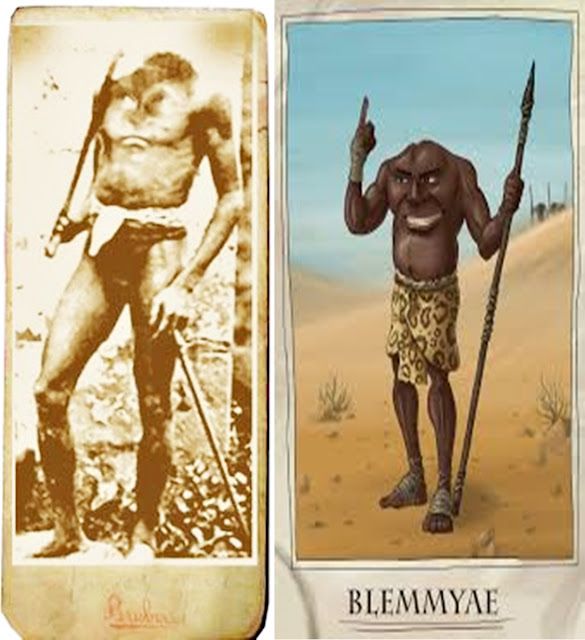
Originally, the Blemmyes were not mythical beings at all. Historical records indicate that they were a real nomadic tribe living in Nubia, in the region south of Egypt. Over time, however, descriptions of them became increasingly fantastical, transforming a real people into legendary monsters.
The earliest account dates back more than 2,500 years. In his work Histories (5th century BCE), the Greek historian Herodotus wrote of “headless creatures with eyes on their chests,” as reported by Libyans. He located them in western Libya, a remote and dangerous land believed to be filled with wild animals, giant serpents, horned donkeys, and other strange beings.
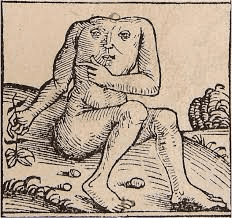
Later writers offered differing perspectives. The Greek geographer Strabo, writing in the 1st century BCE, mentioned the Blemmyes simply as a tribe living along the Nile and near the Red Sea, with no monstrous features. Yet the more sensational version endured. In Natural History, the Roman author Pliny the Elder famously stated:
“The so-called Blemmyes have no heads, but their eyes and mouths are on their chests.”
During the Middle Ages, the legend spread even further. In the 14th century, The Travels of Sir John Mandeville described the Blemmyes as a “cursed race of headless people with eyes on their shoulders.” Interestingly, Mandeville relocated them from Africa to a distant island in Asia—reflecting how myths evolved as they traveled across cultures.
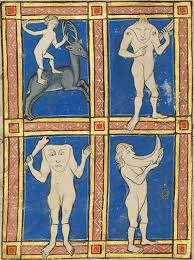
The story did not end there. In the 16th and 17th centuries, English explorer Sir Walter Raleigh wrote about a similar group known as the Ewaipanoma, whom he claimed had eyes on their shoulders and mouths in the middle of their chests, encountered during his journeys in South America.
Today, few scholars believe that such creatures ever truly existed in the form described by ancient writers. Historians suggest that these legends may have arisen from misunderstandings, exaggerated traveler accounts, cultural differences, or rare physical deformities. Others believe the stories were symbolic, reflecting fear of the unknown. Some modern science-fiction writers have even speculated—purely imaginatively—that the Blemmyes could have been extraterrestrial beings.
So who were the Blemmyes really—misrepresented humans, mythological monsters, or something else entirely? And why did so many respected ancient authors describe them with such confidence?
The image shown here is claimed by some to be a real photograph of a Blemmyes. Whether fact or fabrication, the mystery continues.
This narrative doesn’t match up to the photos. Do something pulled together and stop practicing your AI stories at the…


thank for your comment