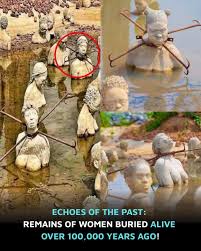
The haunting image of women chained, bound, and buried alive has circulated for centuries, appearing in myths, legends, and popular imagination. These stories often suggest a brutal past where women were routinely punished in unimaginable ways. But when archaeology replaces speculation, a far more complex—and surprising—picture emerges.
Recent discoveries show that while such burials did occur, they were rare, highly specific, and deeply tied to cultural or religious beliefs, rather than widespread acts of cruelty.
One of the most striking finds comes from a Byzantine-era grave near Jerusalem, dated to the 5th century CE. Archaeologists uncovered the skeleton of an individual wrapped in heavy metal chains. At first, researchers assumed the remains belonged to a man. However, advanced peptide analysis of tooth enamel later confirmed the individual was female.
Rather than indicating punishment, scholars now believe the chains symbolized an ascetic religious lifestyle. During this period, extreme self-denial and physical restraint were practiced by some deeply devout individuals—both men and women—as a form of spiritual discipline. In this case, the chains likely represented devotion, not condemnation.

Another discovery tells a darker story. In southern France, a Neolithic tomb dating back to around 5400 BCE contained the remains of three women. Two showed clear evidence of being bound in a ritual known as incaprettamento, where the neck was tied to bent legs, causing death through self-strangulation.
This practice is believed to have been part of agricultural or fertility rituals, where human sacrifice was seen as a way to appease spiritual forces. While disturbing, these burials reflect ritual behavior rather than everyday treatment of women within Neolithic communities.
Together, these findings challenge a long-held assumption: that women in ancient societies were commonly chained and buried alive as punishment. Archaeological evidence suggests the opposite. Such practices were exceptional, not universal—reserved for specific religious, ritualistic, or ascetic contexts.
Understanding these discoveries reminds us that ancient societies were not monolithic. They were complex, varied, and shaped by beliefs very different from our own. To truly understand the past, we must move beyond myths and examine the evidence with care, context, and critical thinking.
- กทม. วิกฤต! ประกาศเตือนภัยซ้ำซ้อน “ร้อนระอุ-ฝุ่นคลุ้ง” ทั่วเมือง: วิธีดูแลตัวเองให้ปลอดภัย
- วิกฤตการณ์ทางทะเล: สัญญาณเตือนภัยสำหรับประเทศไทย
- The three monkeys began to like the monkey doll. The three of them slept, hugged, and kissed
- This Is No Anna’s Fault! Why Monkey Amina Scared?
- When he was very tired, the older monkey would drop his younger brother to get some relief. 💥🐒📌👇