They packed champagne for a celebration at the North Pole, convinced that the wind would carry them to glory. Instead, the ice carried them into silence for thirty-three years, until a melting snowbank finally revealed their fate.
In the summer of 1897, the world watched as Swedish engineer S. A. Andrée prepared to defy nature itself. His plan was audacious: he would reach the North Pole not by sledge or ship, but by hydrogen balloon, a marvel of Victorian optimism. Andrée, along with Nils Strindberg and Knut Frænkel, intended to float over the Arctic ice cap and land safely on the other side.
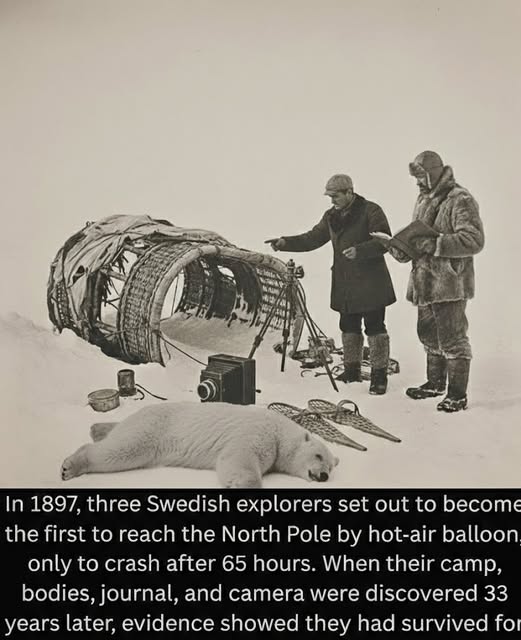
The launch was spectacular, a triumph of courage and technology. But the Arctic rarely cooperates with human ambition. Almost immediately, reality intervened: fog froze onto the balloon’s silk, adding tons of weight, and the drag ropes meant to guide the craft failed.
After just sixty-five hours of erratic flight, the balloon was forced down onto the drifting pack ice, hundreds of miles from civilization. What began as an ambitious expedition became a desperate struggle for survival.
The men salvaged supplies from the balloon’s basket, including scientific instruments, cameras, and provisions. They began hauling heavy sledges across the frozen expanse, a grueling ordeal as the ice often drifted backward faster than they could walk. Yet despite the hopelessness, they maintained discipline. They hunted polar bears and seals, recorded meticulous journals of weather and terrain, and continued taking photographs—even as their bodies weakened and the Arctic winter closed in.
Eventually, they reached Kvitøya (White Island), a desolate rock in the Svalbard archipelago. Here, their strength finally gave out. They died, and their camp was quickly buried under snow. The world assumed they were lost forever.
It was not until 1930, thirty-three years later, that a Norwegian vessel discovered their final resting place. Remarkably, the snow had preserved their equipment, journals, and rolls of undeveloped film. When the photographs were developed decades later, the expedition transformed from a distant tragedy into a vivid human story.
We could see the men standing by the crashed balloon, faces straining as they pulled sledges. Their journals and photos confirmed they had survived far longer than anyone imagined, sustained by hunting and sheer willpower.
Today, the Andrée expedition stands as a testament to both human courage and the limits of technology. It reminds us that even when ambition fails, the human spirit can endure against almost impossible odds.
Leave a Comment