
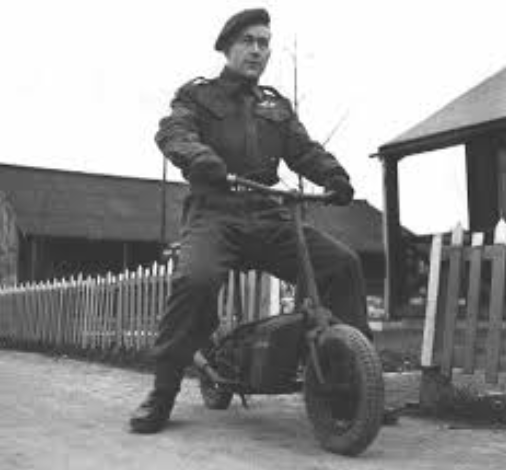
During World War II, British paratroopers faced a major challenge: how to bring mobility with them when dropping behind enemy lines. Their solution was ingenious — the Welbike, a tiny, compact, folding motorcycle designed specifically for airborne operations.
Developed in 1942 by the British firm Excelsior, the Welbike was built to be light, simple, and easy to transport. It weighed just around 32 kg (70 lbs) and was designed to fit inside a standard airborne parachute container, making it perfect for paratroopers. Unlike conventional motorcycles, it had no suspension and only a single-speed gearbox, reflecting its purpose as a short-distance, quick mobility tool rather than a long-haul vehicle.
The bike’s engine was a 98cc two-stroke, capable of carrying a soldier and his gear at speeds up to 30 mph (48 km/h). Once dropped by parachute, soldiers could quickly unfold the bike and use it to traverse enemy territory faster, carry supplies, or perform reconnaissance.
The Welbike saw action in several key operations, including the Normandy landings (D-Day) in 1944, where paratroopers relied on these tiny machines to move swiftly across the battlefield after landing. Despite its simple design, the Welbike became an iconic example of wartime ingenuity, showing how practical engineering could solve even the most unusual military problems.
Today, surviving Welbikes are rare collector’s items, celebrated for their innovative design and role in airborne warfare history.
Leave a Comment